Vietnamese TTS on a Low-End 4-Core PC, No GPU
The goal: a Vietnamese voice that runs on a cheap machine without a graphics card, to voice product videos every day. Instead of trusting each model’s own speed claims, each model was installed on a low-end machine and timed. These are the results, including the models that could not keep up.
The test machine
A typical budget mini PC: Intel N100 CPU with 4 cores and 4 threads (up to 3.4 GHz, about 6 W), 8 GB RAM, a 120 GB SSD, no discrete graphics card, Ubuntu 24.04. That is roughly the power of a cheap office laptop or an old desktop, far below a gaming PC. If a model runs well here, it runs almost anywhere.
What was measured: RTF
RTF (real-time factor) is the time it takes to generate audio divided by the length of that audio. An RTF of 0.5 means 8 seconds of speech is ready in 4 seconds. Above 1, the model is slower than speaking, and the user waits.
Every model read the same short sales sentences of about 8 seconds. Small models were run 7 times and the median was taken. Large models ran only once or twice because each run takes minutes.
Results on the 4-core machine
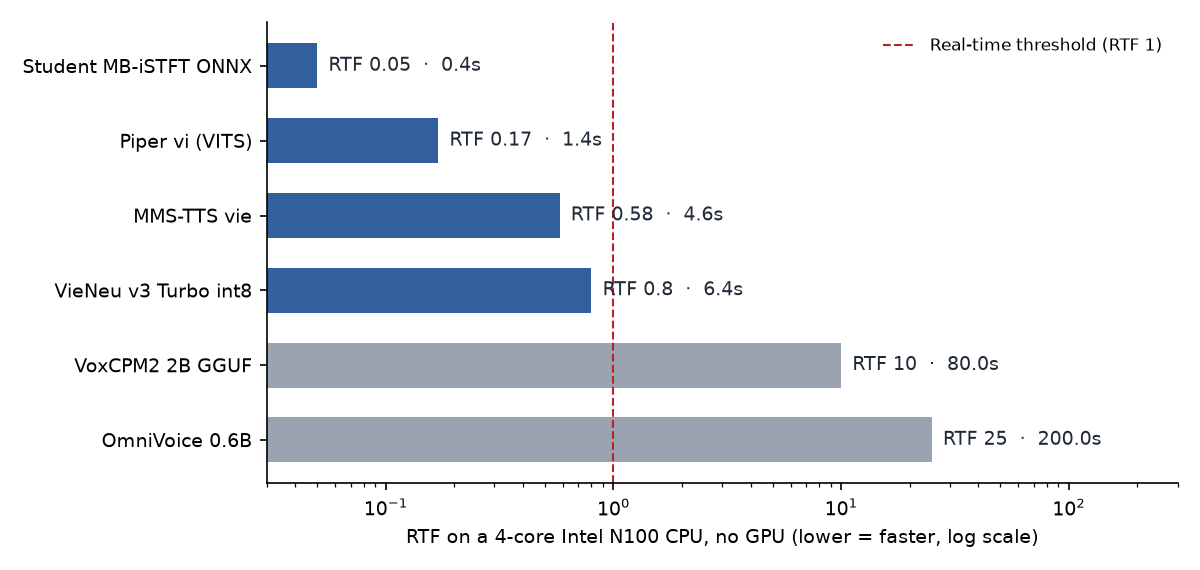
| Model | RTF on low-end CPU | 8 s of audio takes | Notes |
|---|---|---|---|
| OmniVoice 0.6B (fp32, 16 steps) | ~25 | ~215 s, plus 260 s to load | Best voice by ear, far too slow on CPU |
| VoxCPM2 2B (GGUF Q4/Q8) | 9–11 | ~80 s | Uses ~4.7 GB RAM |
| F5-TTS Vietnamese 337M | not isolated | ~330 s including load | Needs a GPU |
| VieNeu v3 Turbo (int8 ONNX) | ~0.8 | 6.7 s | 23 voices, natural, 21 s to load |
| MMS-TTS vie | ~0.58 | 7 s for 12 s of audio | Low quality |
| Piper vi (VITS) | ~0.17 | 1.4 s | Fast, but sounds robotic |
The three best-sounding models (OmniVoice, F5-TTS, VoxCPM2) were 10 to 40 times slower than real time on this 4-core machine. That comes from their architecture: 0.3 to 2 billion parameters and many generation steps. Code tuning gains 2–8×, while the target needed 50–100×.
Compared with an RTX 3050
The same OmniVoice in fp16 on an RTX 3050 6 GB made an 8.4 s sentence in 3.1 s (RTF 0.37) with 16 steps, and in 6.2 s with 32 steps. Batching 2 or 4 sentences did not raise throughput because the GPU was already fully busy. So big models are fine on a mid-range GPU, not on an office PC or a mini PC.
The fix: a small student model
OmniVoice (running on the GPU) read about 9,000 sentences, which were then used to train a small model (MB-iSTFT-VITS, about 24 million parameters) to imitate that voice. Training ran on Kaggle’s free T4 GPUs, up to 11.3 hours per session. The student is exported to ONNX with fp16-stored weights, so the file is only 35 MB.
Benchmark log on the Intel N100, 4 threads, 7 runs per configuration:
2026-11-19 00:43:48 threads 4, runs 7
model                   MB     load(s)  RTF median (min–max)       8s audio(s)  RSS MB
mb_rb1_512.onnx         110.4  0.471    0.1503 (0.1498–0.1507)    1.20         413
mb_rb1_512.int8.onnx     37.5  0.636    0.2264 (0.2262–0.2279)    1.81         268
mb_rb2_384.onnx          69.3  0.406    0.0498 (0.0493–0.0502)    0.40         311
mb_rb2_384.int8.onnx     23.7  0.558    0.0725 (0.0710–0.0731)    0.58         223
mb_rb2_384.fp16w.onnx    35.0  0.459    0.0495 (0.0491–0.0506)    0.40         350
mb_rb1_256.fp16w.onnx    35.4  0.427    0.0600 (0.0598–0.0617)    0.48         314
The chosen configuration is mb_rb2_384.fp16w: 8 seconds of audio in 0.4 seconds, under half a second to load, about 350 MB of RAM. After real training the speed stayed the same (RTF 0.045–0.05).
Three surprises
- int8 quantization made it slower. On this low-end CPU, dynamic int8 was 45–50% slower than fp32 and noticeably worse (SNR against the original only 7–9 dB). Storing weights as fp16 and casting to fp32 at load time halves the file and keeps fp32 speed.
- The N100 was about 2.1× slower than a Ryzen 5 5600X (a 6-core desktop CPU) for this model, not the 1.5× estimated from Piper. Measure on the machine you will actually ship to.
- Automatic metrics missed the “robot voice”. The student’s character error rate (0.89%) matched the teacher’s (0.93%), yet listeners still heard flat rhythm. Prosody still has to be judged by ear.
Limits of this test
- One machine (Intel N100). Others with the same chip can differ by 10–20% depending on cooling and RAM.
- Large models were timed only a few times, so treat those numbers as orders of magnitude. The ranking is solid.
- OmniVoice, F5-TTS and MMS weights are non-commercial (CC-BY-NC). For commercial use, pick an Apache-licensed teacher such as VieNeu v3 Turbo or VoxCPM2.
Try it
The Vietnamese text to speech tool on this site runs a small model of this kind right in your browser. Your text never leaves your device, and it works on slow machines too. For voicing product videos, see the voice-over guide.
- CER, UTMOS and DNSMOS Can't Catch a Robotic TTS VoiceA Vietnamese TTS model had 0.89% CER, level with the large model, yet sounded robotic. Why CER, UTMOS and DNSMOS miss rhythm, and the use_sdp culprit.
- Training TTS on Free Kaggle T4 GPUs vs an RTX 3050Training a voice model on free Kaggle 2×T4 ran 3.8× faster than an RTX 3050 6 GB. Throughput, VRAM and 5 silent traps that cost hours of GPU time.