CER, UTMOS and DNSMOS Can't Catch a Robotic TTS Voice
A small voice model (covered in Vietnamese TTS on a low-end PC) learns from a large model acting as teacher. After training, the small model’s character error rate (CER) was 0.89%, level with the teacher (0.93%). By the numbers, it passed. But the first listening test found the voice flat, lacking rhythm, with numbers read in a monotone. This post records why the automatic metrics missed it and how the real cause turned out to be one config parameter.
The metrics used
- CER: a Vietnamese speech recognizer (PhoWhisper-large) listens to the audio and compares it with the source text. Lower is better.
- UTMOS: a “naturalness” score predicted by a pretrained model, on a 1–5 scale.
- DNSMOS: a quality score (clear speech, little background noise) published by Microsoft.
- Estimated SNR: the energy gap between the loudest and the quietest parts of a file. A rough estimate.
UTMOS and DNSMOS were trained mostly on English. Their scores are only meaningful relative to each other within one language.
Finding 1: CER cannot tell “robotic” from “natural”
On the 120,900-step checkpoint, CER on 50 plain sentences was 0.89% (0.96% when re-measured on 22 Nov), against 0.93% for the teacher. The only errors CER caught were long numbers being swallowed, such as “three thousand five hundred” turning into “three five”. Rhythm is invisible to CER: a flat reading is still correct word for word.
The cause, found by re-reading the code: the duration predictor in MB-iSTFT-VITS defaults to use_sdp=False, meaning deterministic. Every sentence gets the same rhythm. The noise_scale_w parameter (the randomness of the rhythm) had no effect: values of 0.4, 0.8 and 1.2 produced audio of identical length. The config did not set it, so the model silently used the default.
With use_sdp=True and the old checkpoint reloaded (only the new duration predictor was trained from scratch, adding about 1 million parameters), speed on the N100 changed only from RTF 0.045 to 0.050. The voice read about 15% faster, with more natural rhythm. CER got worse:
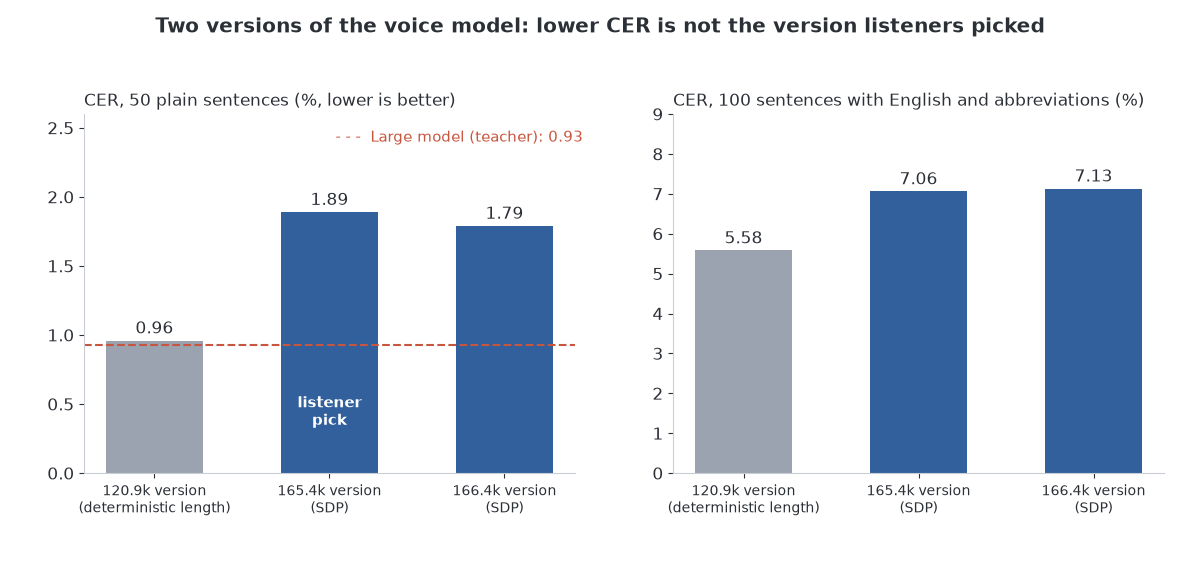
| Model version | CER, 50 plain sentences | CER, 100 English + abbreviation sentences | Listener |
|---|---|---|---|
| 120.9k, deterministic length | 0.96% | 5.58% | flat, numbers monotone |
| 165.4k, SDP | 1.89% | 7.06% | picked |
| 166.4k, SDP | 1.79% | 7.13% | not picked |
CER roughly doubled, the bad direction, yet the listener picked the SDP version for its natural rhythm and fluent numbers. The SDP version does swallow numbers more often (“sixty-seven watts” becoming “watts”), which CER catches correctly. A better metric does not mean better listening; the two measure different things.
Finding 2: UTMOS and DNSMOS miss things too, in another way
The automatic scorers ran over 65 voice samples in several languages. Real output for 4 files:
name         UTMOS  SIG   BAK   OVRL  SNR(dB)
ms_2_clone   3.59   3.61  4.08  3.33  45.4
ms_i2s1      3.18   3.61  3.81  3.14   8.9
ms_ins3      1.30   1.19  1.16  1.07  12.6
ph_3_clone   1.51   3.23  3.86  2.88  75.5
ms_i2s1 has a UTMOS of 3.18 and an overall DNSMOS (OVRL) of 3.14, almost level with the clean file ms_2_clone, yet its SNR is only 8.9 dB: continuous background noise nearly as loud as the speech. Of the 13 files with SNR under 15 dB, 5 still scored UTMOS 2.5 or higher. The correlation between UTMOS and estimated SNR across the 65 files is just −0.13, which is close to unrelated.
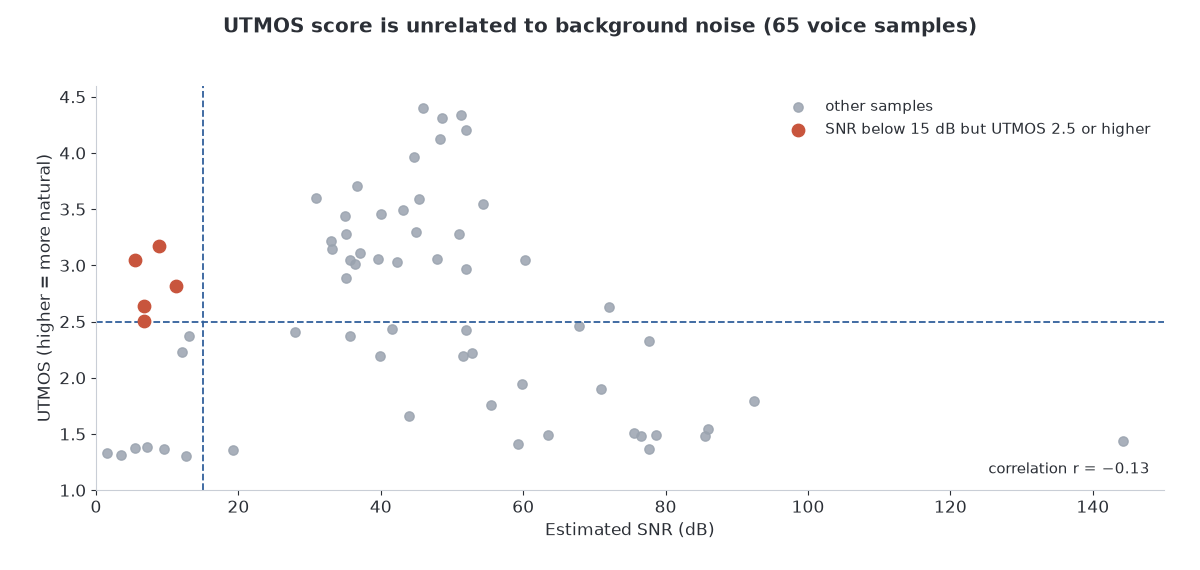
The opposite direction exists too: ph_3_clone got a UTMOS of only 1.51, while its SNR is 75.5 dB and it sounds fine. UTMOS was trained on English, so it may penalize voices in other languages.
A useful side finding: among 15 Malay samples generated from a text description, 13 had an estimated SNR under 15 dB (continuous noise nearly as loud as speech), while 26 voices generated from a reference sample had SNR from 28 to over 80 dB. To filter these out, an SNR threshold (under 15 dB) is needed next to the UTMOS and DNSMOS scores.
Takeaways
- CER measures intelligibility, that is, whether words are swallowed or misread. It does not measure rhythm, emphasis or how human the voice sounds.
- UTMOS and DNSMOS cannot replace human ears outside English, and can give high scores despite heavy background noise.
- One default parameter (
use_sdp=False) was enough to make the voice flat while every metric looked good. When a voice sounds robotic but the numbers are fine, check the parameters that drive rhythm before training further.
Limits of the measurement
- One listener, with 3 samples A/B/C. This is not a statistical MOS. “Listener pick” is one person’s opinion.
- CER was measured on 50 and 100 sentences, a small sample. A 0.1% gap between versions is within measurement noise, so only the general direction (SDP about 2× worse) should be trusted, not individual figures.
- The 65 samples span several languages and two ways of generating voices, with few samples per group. The −0.13 correlation describes this sample set only.
- SNR is a rough estimate (frame energy gap); a few very high values (over 100 dB) reflect absolute silence, not quality.
- UTMOS and DNSMOS were run as published, not tuned for Vietnamese.
Try it
The voice model in this post runs right in the browser: try the Vietnamese text to speech tool. For how it was trained and the failures on free GPUs, see training TTS on free Kaggle T4 vs an RTX 3050.
- Training TTS on Free Kaggle T4 GPUs vs an RTX 3050Training a voice model on free Kaggle 2×T4 ran 3.8× faster than an RTX 3050 6 GB. Throughput, VRAM and 5 silent traps that cost hours of GPU time.
- Vietnamese TTS on a Low-End 4-Core PC, No GPU6 Vietnamese text-to-speech models timed on a low-end 4-core PC with no GPU: which keep up in real time, which need a GPU, and a 35 MB winner.