Picking a Small Language Model for Vietnamese on a Weak PC
The requirement: a language model that runs on a machine without a graphics card and writes a Vietnamese ad text of about 90 words in under 15 seconds. Fifteen seconds is a tolerable wait when making product videos in bulk. Instead of trusting vendor speed claims, 8 small models were downloaded and timed on the same low-end machine.
How it was measured
The test machine is a 4-core mini PC (Intel N100, 8 GB RAM) with no GPU. Each model was quantized to Q4_K_M and run with llama.cpp on 4 threads. Two numbers came from llama-bench:
- Prompt reading: tokens processed per second when loading 512 input tokens.
- Generation: tokens produced per second (128 tokens). This is where most of the waiting time goes.
Neither number is wall-clock time, because each tokenizer splits Vietnamese into a different number of tokens. So every model was also run over 30 Vietnamese texts to count tokens relative to Qwen3.5. The estimated time for one Vietnamese text is prompt-reading time plus generation time, scaled by that relative token count.
Results
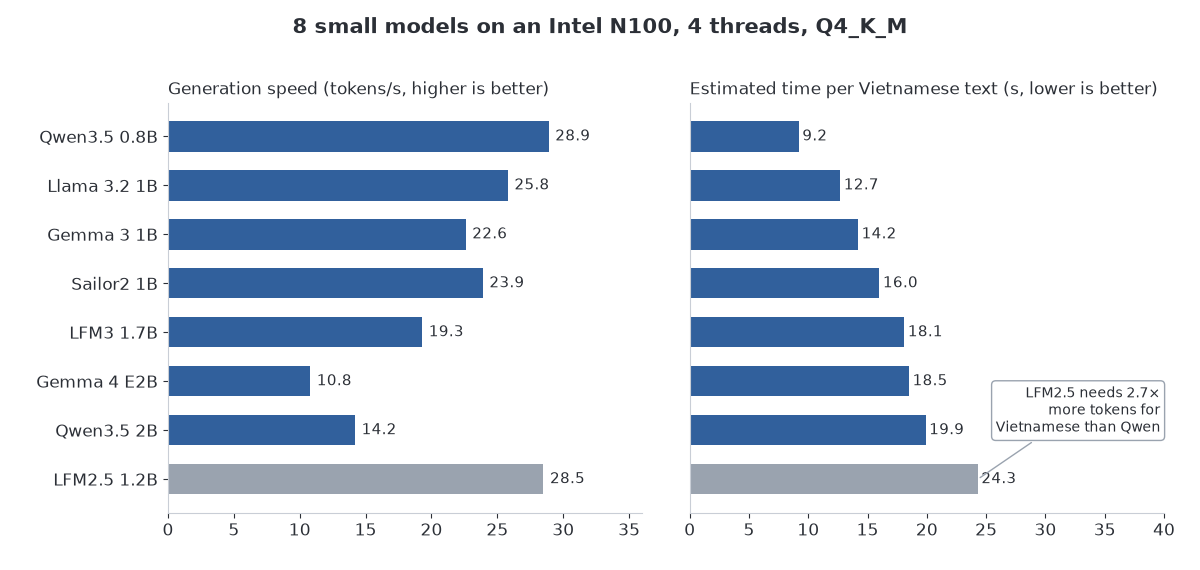
| Model | Q4 file | Prompt (tok/s) | Generation (tok/s) | Vietnamese tokens vs Qwen | Estimated time per text (s) |
|---|---|---|---|---|---|
| Qwen3.5 0.8B | 0.52 GB | 92.0 | 28.9 | 1.00× | 9.2 |
| Llama 3.2 1B | 0.80 GB | 62.1 | 25.8 | 1.15× | 12.7 |
| Gemma 3 1B | 0.80 GB | 54.7 | 22.6 | 1.06–1.10× | 14.2 |
| Sailor2 1B | 0.73 GB | 46.9 | 23.9 | 1.17× | 16.0 |
| LFM3 1.7B | not recorded | 43.2 | 19.3 | 1.14× | 18.1 |
| Gemma 4 E2B | 3.09 GB | 91.3 | 10.8 (±1.9) | 1.06–1.10× | 18.5 |
| Qwen3.5 2B | 1.27 GB | 39.9 | 14.2 | 1.00× | 19.9 |
| LFM2.5 1.2B | 0.73 GB | 58.6 | 28.5 | 2.7× | 24.3 |
Qwen3.5 0.8B is fastest on both counts, at roughly 9 seconds per text. Llama 3.2 1B (12.7 s) and Gemma 3 1B (14.2 s) are also under the 15-second line, though Gemma 3 only just. The rest take 16 to 24 seconds.
Surprise 1: high generation speed is not always fast
LFM2.5 1.2B generates 28.5 tokens/s, almost level with Qwen 0.8B and above every other 1B model. But its 65k-token vocabulary has no Vietnamese, so one Vietnamese text costs 2.7 times as many tokens. The result: the second-fastest model by tokens/s is the slowest in practice (estimated 24.3 s). The 116 tok/s figure in the vendor’s material did not reproduce on this machine.
The opposite also holds: Qwen’s large vocabulary is not a burden on CPU. Counting tokens in the target language matters as much as measuring tok/s.
Surprise 2: RAM bandwidth caps speed, not core count
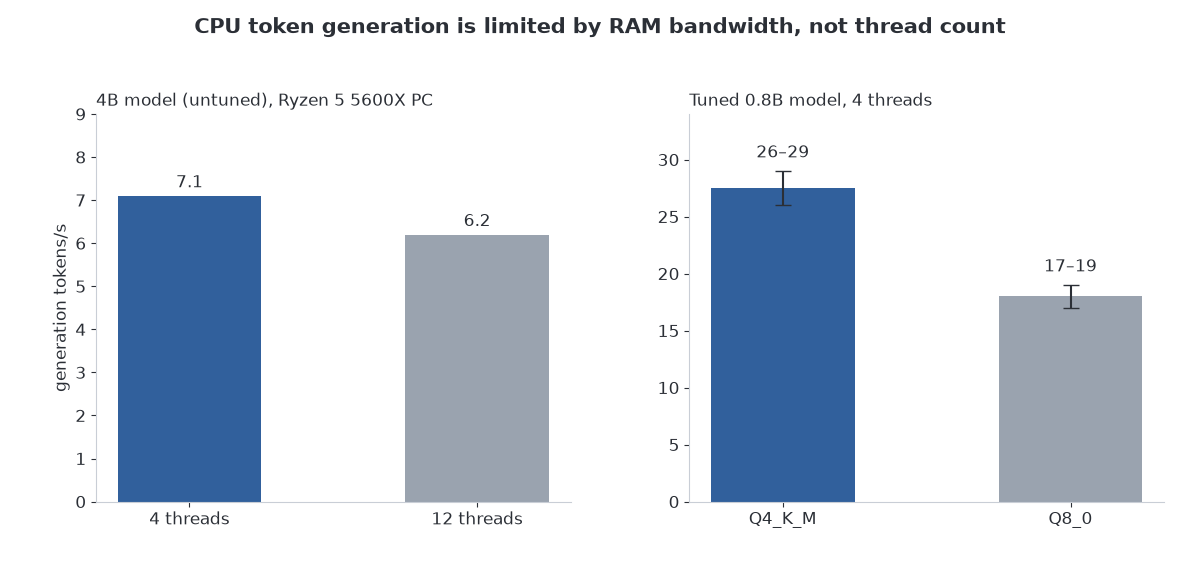
- A 4B model (untuned) on a Ryzen 5 5600X PC: 4 threads generate 7.1 tokens/s, 12 threads only 6.2. Extra threads do not help and even hurt. Prompt reading does scale with threads (74 to 106 tokens/s), but prompts are short, so it matters little.
- A tuned 0.8B model on 4 threads: Q4_K_M generates 26–29 tokens/s, Q8_0 only 17–19. In wall-clock terms a script takes 8.0 s (Q4) versus 11.7 s (Q8) in template mode, and 5.5 s versus 8.9 s in free-writing mode. The Q8 file is twice the size, and no cleaner in output.
- Multiplying generation speed by file size for 6 models (Gemma 4 E2B excluded) gives roughly 15–21 GB/s read through RAM, fairly consistent. This is a rough calculation from the table, ignoring cache and other overheads, but it explains why smaller files run faster.
- The N100 limited to 4 threads generates 28.9 tokens/s, almost the same as a Ryzen 5 5600X limited to 4 threads (28.6). Prompt reading is about 3.5 times slower on the N100 (Qwen 2B: 40 versus 144 tokens/s).
Practical conclusion: a 4-core machine running a small model is about as fast as a many-core one. A smaller model and lower-bit quantization help more than extra cores.
Speed is only half of it
On 20 test products, the number of texts free of automatic flags (invented numbers, wrong length, copied example sentences) before any tuning was: 0.8B got 2, 2B got 2, 4B got 11, 9B got 14. In other words, models good enough (4B and up) take 45–60 s on CPU, while the fast ones write poorly. That is what led to fine-tuning the 0.8B and 2B models, covered in a post on common mistakes small models make writing Vietnamese ads (in Vietnamese).
Limits of the measurement
- Only speed was measured, not writing quality of the 8 base models. “Fastest” does not mean “writes best”.
- The per-text time is an estimate, not a full end-to-end run for each model. The same short free-writing text size was used for input and output tokens.
- Each
llama-benchmeasurement has only 3 repeats. Gemma 4 E2B swings widely (9.4–12.9 tokens/s). A machine with another user active is worse: the same 2B model gave 10.5 and 16 tokens/s in two runs. - The thread-count and Q8 comparisons ran on a Ryzen 5 5600X PC, not the N100, with few runs.
- Vietnamese token counts come from 30 texts in an advertising vocabulary. Other text may give different ratios.
- Model licenses differ (Apache, Gemma terms, Llama Community, LFM). Read them before commercial use.
See also
The same weak machine can also run a voice: 6 Vietnamese TTS models timed on a 4-core CPU. A finished script can be read aloud with the Vietnamese text to speech tool, which runs right in the browser.