A Daily SEO Routine for an AI Agent: Workflow and Limits
A new tools website needs the same small jobs every day: open the numbers, find queries that get impressions but no clicks, rewrite a title, publish an article. The work is small and easy to forget. The experiment hands it to an AI agent (Claude Code, running on the 8 GB mini PC from the previous post) on a 9 a.m. schedule, with one hard constraint: the agent may only open a pull request (PR), and nothing reaches the site until a person reviews it.
The morning workflow
- Collect numbers. A script reads Search Console and Bing through their official APIs (read-only), plus Umami, the tool-events table and a site health check. No browser is opened.
- Pick exactly one task, in priority order: incident (site error, tracking alert) → a change that is due for re-measurement → a Search Console opportunity (a query with 3 or more impressions at position 4–20, or a low click-through rate for its position) → new content (Mondays and Thursdays only) → new tool (Mondays only). If nothing is new, no PR is opened.
- Check: the web build must pass the automated SEO checks with 0 errors.
- Add one line to the change log, with a re-measurement date 21 days later.
- Open a PR and send a short chat report. Changes in the PR are labelled as not yet live.
Guardrails
The rules live both in the agent’s instructions and in the tool permission file, so a violation is blocked rather than merely discouraged:
| Allowed | Not allowed |
|---|---|
| Read numbers through the script, read and edit content files, run build and tests | Deploy, push directly to the main branch, merge a PR |
| Commit and push to its own branch, open a PR | SSH into servers, touch the database, run deploy commands |
| Write the change log | Change page URLs, delete live pages, loosen the SEO check rules |
| Report “needs you” when a permission is missing | Invent numbers; work on more than one topic a day; open a new PR while 2 are waiting for review |
Each run has a preset budget cap (3 USD). The actual cost of each run was not recorded.
Runs and duration
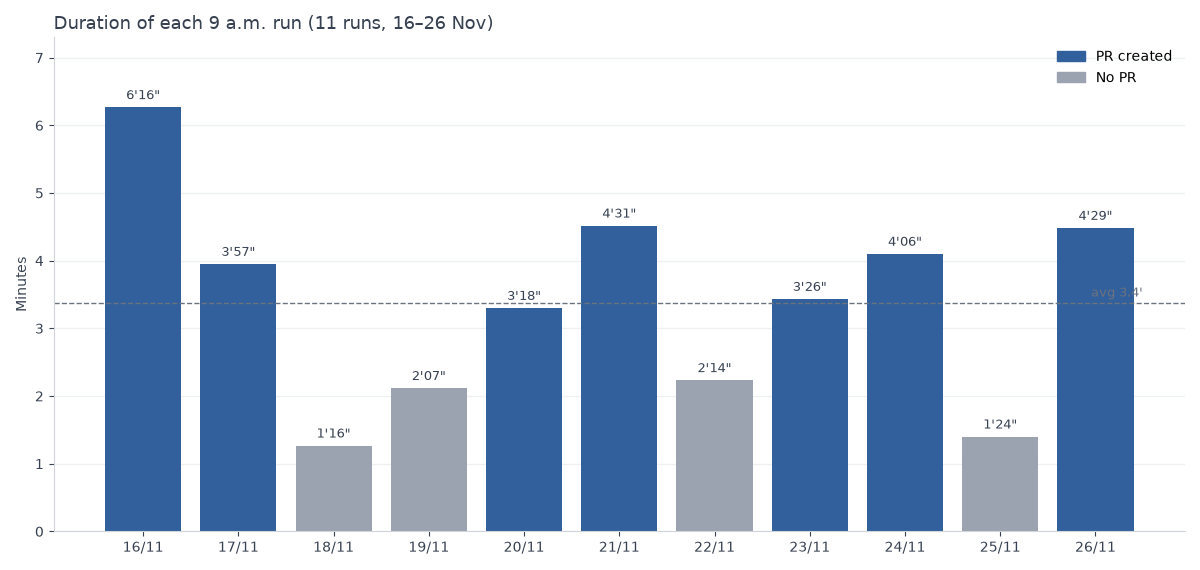
All 11 runs finished normally. Durations ranged from 1 minute 16 seconds to 6 minutes 16 seconds, averaging 3.4 minutes (start to finish, build included). The longest was the very first run at 6 minutes 16 seconds.
Outcome of the 11 runs:
| Outcome | Days | Dates |
|---|---|---|
| PR opened | 7 | 16, 17, 20, 21, 23, 24, 26 Nov |
| No PR: 2 PRs already waiting for review | 2 | 18, 19 Nov |
| No PR: no new signal | 2 | 22, 25 Nov |
All 7 PRs were merged, plus 2 PRs from the earlier trial phase, for 9 merged growth PRs in total. Time from opening to merge depended on the reviewer:
| PR | Change | Open → merge |
|---|---|---|
| #3 | New article on moving iPhone photos to Windows (vi + en) | 3 days |
| #4 | Extended the English subdomain-finding article to match queries | 2 days |
| #5 | Title fix on the ChatGPT library cleanup page (en); branch pushed by a person, see below | same day |
| #6 | Meta description and FAQ for the photo-booth-at-home article | 2 days |
| #7 | Fix for a missing view event on the text-to-speech tool | 6.5 hours |
| #8 | ChatGPT “storage full” article | 1 hour |
| #9 | Bank-transfer QR vs payment QR article (vi + en) | 13 minutes |
Review time shrank from days to under an hour. The cause (a less busy reviewer, smaller PRs, or clearer reports) was not tested.
What the agent did well and badly
Well:
- Found real tracking defects: a text-to-speech tool was missing its view event (fixed in PR #7). Some “silent analytics” alerts also turned out to be false alarms on tools that change pages without a reload; the report script was fixed on 24 Nov.
- Ignored queries from an older site that once ran on the same domain, as instructed.
- Stayed inside the boundary. On 20 Nov the push command was blocked for lack of permission; the agent did not look for a workaround and reported “needs you” with the exact command and PR text ready. The allow list now contains exactly one push command, for its own branch, and from 21 Nov PRs open automatically.
- Recorded bad results too: a change to the top of the mobile home page was logged as “could not be measured”, because there was no earlier baseline and no click event.
Badly:
- Trusting its input. For three days in a row (17–19 Nov) the agent flagged the file-transfer tool as “only 44% successful” and asked for a bug hunt, while the figure came from faulty counting. Details in the post on the 44% success rate (Vietnamese).
- No verdict on SEO effect yet. The change log has 16 entries; only 1 has a conclusion (and it is “could not be measured”). The first re-measurement date is 30 Nov. Overall numbers are in the first 17 days of a new tools website.
Limits of the measurement
- Only 11 runs over 11 days. Not enough to say anything about long-term results.
- Durations come from start and end log lines and include build waiting time; steps are not separated.
- Tokens and cost per run were not measured (a subscription login is used; only the budget cap is known).
- The merged-PR count includes 2 PRs from the first trial run. Review time depends on the reviewer’s calendar.
- No comparison with a person doing the same SEO work by hand, so no claim that the agent is faster or better.
Further reading
On the same system, the post on running Claude Code 24/7 on a mini PC records tokens and machine resources. The Search Console numbers the agent reads each morning are summarised in the first 17 days of a new tools website.
- Traffic for a New Tools Website: The First 17 DaysReal Search Console and Bing numbers for a new tools website after 17 days: 1,110 impressions, 10 clicks, average position 48, and why it is far too early.
- Running Claude Code 24/7 on an 8 GB Mini PC: Real NumbersTwo weeks of Claude Code running nonstop on a 4-core, 8 GB mini PC: 5,526 API calls, 97% of input read from cache, plus real RAM, heat and swap data.